Configuration
How workloads get their settings from ConfigMaps and their secrets from Secrets.
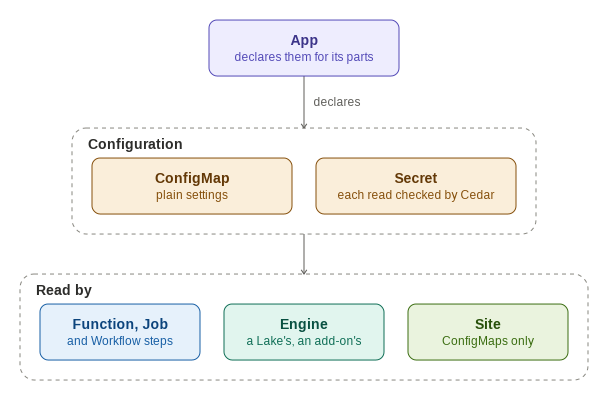
Configuration comes in two kinds of resource. A ConfigMap holds plain settings, and a Secret holds values that must stay private. A Function, a Job, a Workflow and an App define ConfigMaps of their own or name existing ones, and they declare the Secrets that they read, with the keys that they need. A Secret belongs to its namespace: no workload holds, writes or owns one.
Each workload uses its configuration in its own way:
- A Function receives the keys of its ConfigMaps as environment variables. It reads its Secrets through its local API, so their values never reach its environment. A Job's run and a Workflow's steps receive their configuration the same way.
- A Lake's engine receives both as environment variables when it starts, such as its tuning settings and its token. An add-on's engine receives the Secret keys that its Addon lists.
- A Site writes the keys of a ConfigMap into a public configuration file beside its static files. A Site never reads a Secret.
- An App declares the ConfigMaps and the Secrets that its parts use, and it changes no part while a Secret that it declares is missing.
Each Secret read asks Cedar first. A Secret that the reader binds is allowed, and a namespace Policy can forbid it. A Function's reads then fail and its workers stop being ready, and a Lake is held with its engine stopped, until the forbid goes, as the Secrets page describes. funcd encrypts Secrets at rest when it has a key file. Without one, it stores them unencrypted and logs a warning at startup.