Function
Who calls a Function, and what it binds.
Callers
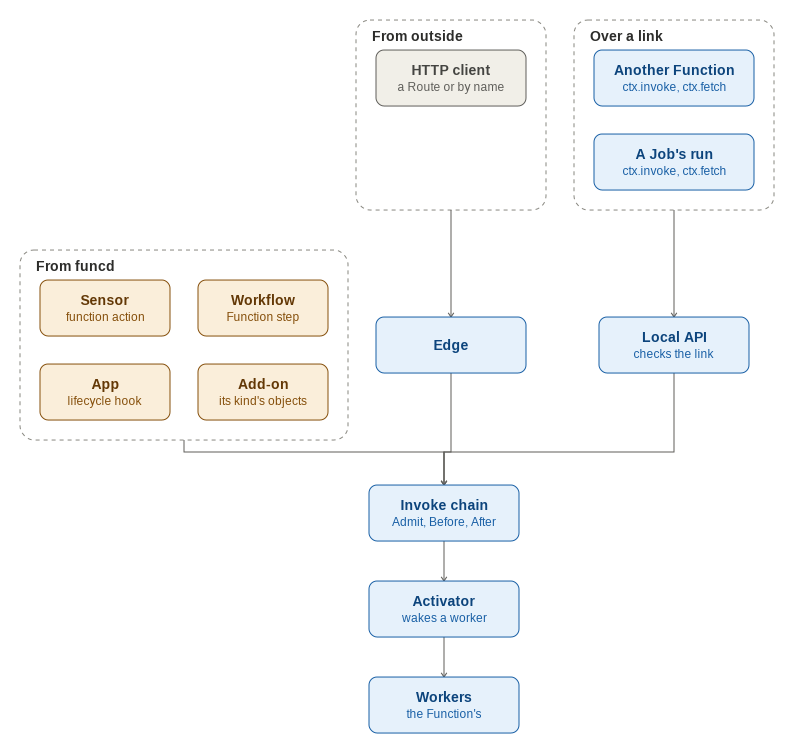
A Function is called from outside funcd or from inside it. From outside, an HTTP client reaches it through the edge,
on one of its Routes or at /function/<name>. From inside, another Function or a Job's run calls it through its local
API, over a link that the caller declares in spec.bindings.links. A Sensor calls it in a function action, a Workflow
runs it as a Function step, an App calls it at a lifecycle hook, and an add-on's settings or engineless kind sends it
the objects to apply.
Every call, whoever makes it, goes through the invoke chain. Admit runs before funcd reads anything about the Function. Before runs before the worker is called or started. After runs on the answer, before the caller sees it. When the Function has no worker running, the activator starts one and holds the call until the worker is ready.
Bindings
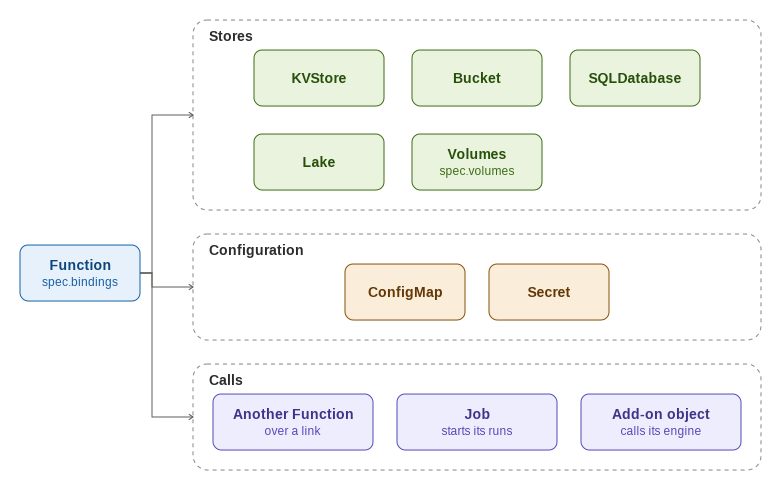
A Function names what it uses in spec.bindings: KVStores, Buckets, SQL databases and Lakes, ConfigMaps and
Secrets, and what it calls: other Functions (links), Jobs and add-on objects. Its volumes come from spec.volumes.
Each store runs on an engine. KV runs in memory by default, or on Badger when the operator chooses the durable engine. A Bucket keeps its objects in files or in S3. A SQL database runs on rqlite, which keeps its data in SQLite. A Lake runs on DuckDB with DuckLake, and keeps its files under a prefix of a Bucket. A volume is a directory of a fixed size on the local disk.