Services
The services that funcd runs for its workloads, how each is reached, and where funcd keeps them on disk.
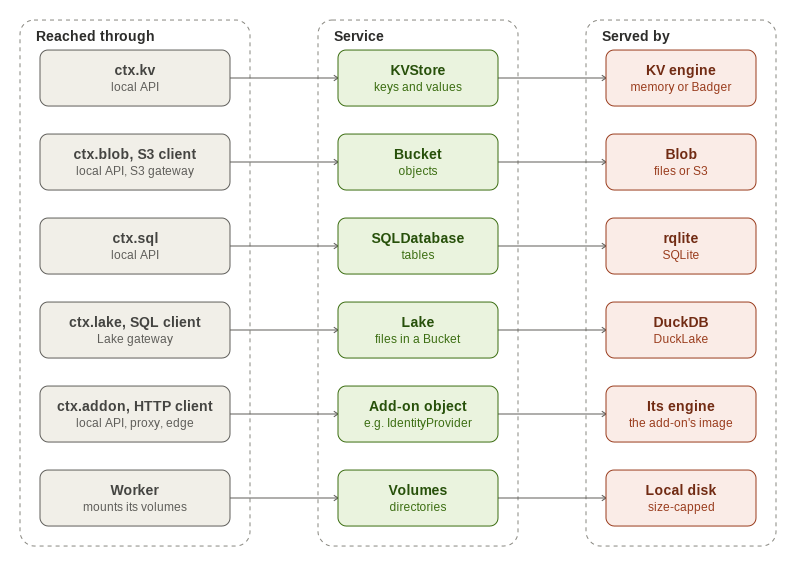
funcd serves the stores a Function binds: a KVStore, a Bucket, a SQLDatabase and a Lake, and the Function's own volumes. A Function reaches KV, its Buckets and its SQL databases through its local API. When the operator turns on funcd's S3 gateway, S3 clients, including a Function, reach a Bucket through it, and a Lake's engine reads and writes its files through it. A Lake answers queries through its Lake gateway. The worker mounts its volumes. funcd also keeps the Secrets that a Function, a Workflow step or a Lake reads, in the metastore. Events are the last service: an EventSource emits them on a timer, on a new object in a Bucket or on a row change in a SQL table, and a Sensor calls a Function or starts a WorkflowRun for each one.
Each store runs on an engine. KV runs in memory by default, or on Badger when the operator chooses the durable engine. A Bucket keeps its objects in files or in S3. A SQL database runs on rqlite, which keeps its data in SQLite. A Lake runs on DuckDB with DuckLake, and keeps its files under a prefix of a Bucket. A volume is a directory of a fixed size on the local disk.
An admin can also register add-ons, engines built outside funcd such as an OpenID Connect provider: funcd runs one engine per object of an add-on's kind, and a Function reaches it through funcd only.
Each service has its own page: KV, Bucket, SQL, Lake, Add-ons, Secrets and Events.
On disk
funcd keeps its stores under one directory, storage.dataDir: