Secrets
Values that a Function or a Lake reads and that a Function may write, each read and write decided by Cedar.
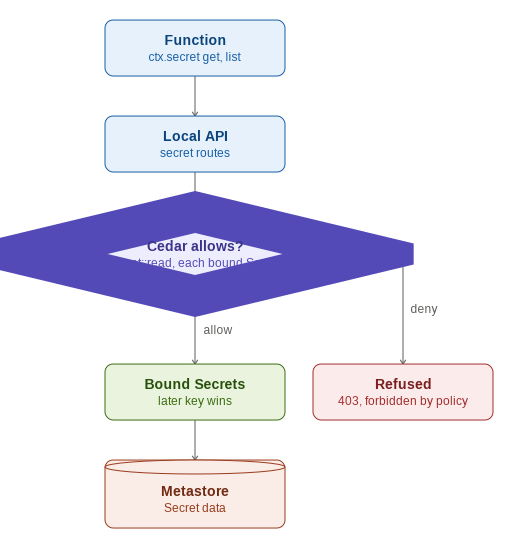
A Secret holds named values, its spec.data, in a namespace. A Function names the Secrets that it reads in
spec.bindings.secret, and a Workflow step and a Lake bind Secrets the same way. A Function reads the values with
ctx.secret.get and ctx.secret.list through its local API, so they never reach the worker's environment. Each read
asks funcd, with no cache: a changed Secret shows at the next read, without a restart. A read resolves every Secret
that the Function binds, and when two of them hold the same key, the later Secret's value wins. A Function can also
write a key of a Secret that it binds, with ctx.secret.put, or remove one, when it is the Secret's owner or a role
allows it to write the Secret. The next read of each Function that binds the Secret shows the change, unless another
Secret that the Function binds holds the same key and comes later in the Function's list of bound Secrets.
Each read asks Cedar whether the Function may secret::read each Secret that it binds. The built-in policy
secret-read-binding allows a bound Secret. The built-in roles Secret Data Reader and Secret Data Writer also
hold secret::read, but a read names only the Secrets that the Function binds, so neither role lets it read more.
Each write asks Cedar whether the Function may secret::write the Secret: the built-in policy allows only the
Secret's owner and the principals that a role such as Secret Data Writer names. A namespace Policy can forbid a read
or a write of a Secret. After a forbid of reads, each of the Function's next reads fails with 403, even for a key that
another Secret holds, and its workers stop being ready within runtime.supervisionPeriod (10 s by default). With no
ready worker, the Function is Degraded and its calls wait. Once the forbid goes, the next check makes the workers
ready again. A forbid of writes refuses each write with 403, and leaves the workers ready.
funcd stores Secrets in the metastore. It encrypts them at rest when secrets.encryptionKeyFile names a key file.
Without one, it stores them unencrypted and logs a warning at startup. People read and write Secrets through the API,
where RBAC decides, as for every other kind.
A Lake's Secrets
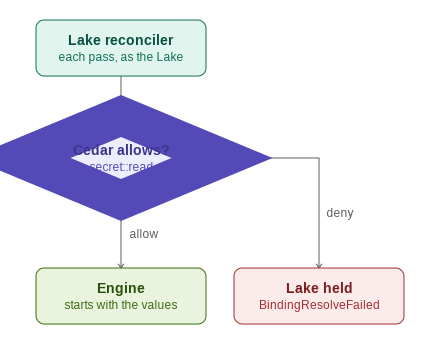
A Lake's engine reads its Secrets, such as its QUACK_TOKEN, from its environment when it starts. The Lake
reconciler therefore asks Cedar, as the Lake, whether it may secret::read each Secret that the Lake binds, and it
asks again on each of its passes. A forbid holds the Lake in Pending with the reason BindingResolveFailed, and it
stops an engine that runs. funcd asks again every controller.referentPollInterval (2 s by default), and once the
forbid goes, the engine starts with the values.