Quotas
How many stores a namespace holds, and how much each store holds.
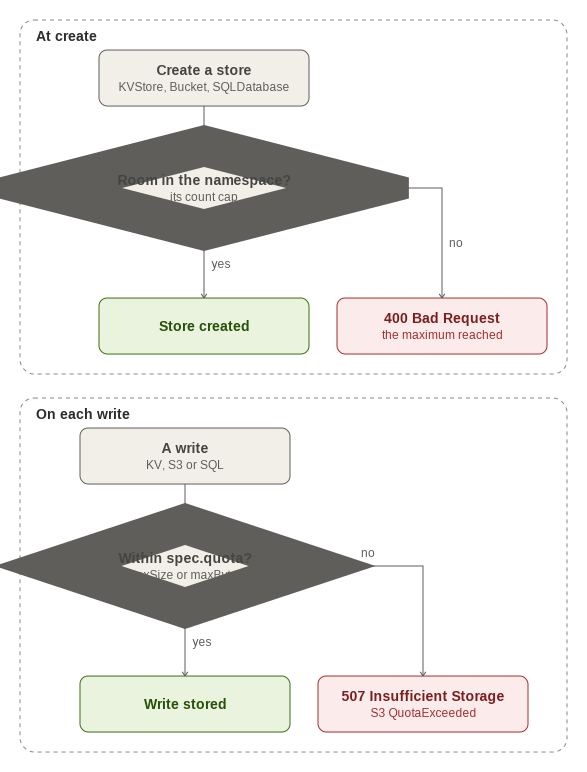
A namespace holds at most 100 KVStores (kvstore.maxStoresPerNamespace), 100 Buckets and 20 SQL databases
(sql.maxDatabasesPerNamespace). The API refuses a create past the cap with 400, and it counts an App's new parts
together.
A store's spec.quota caps its size, with maxSize, such as 10Gi, or maxBytes. A Bucket and each of its prefixes
take one, and so do a KVStore and a SQLDatabase. A Lake's files count against the Bucket prefix that holds them. Every
capped write asks one checker before it stores. A write that would pass the cap is refused whole with 507 Insufficient
Storage, or QuotaExceeded on S3, while reads and deletes go on.
A quota can also cap one item: a Bucket's object (maxObjectBytes, else s3gateway.maxUploadBytes, 1 GiB, refused
with 413), a KVStore's value (maxValueBytes, up to 1 MiB) and its key (maxKeyBytes, up to 64000 bytes).
The checker counts each store's size from a measure that it refreshes every minute. A store's first write after a start, or after 10 minutes idle, waits for a whole measure, at most 2 minutes. A change made outside the store's writes, such as a Restore's load, counts from the next refresh. A Restore can therefore leave a store past its cap, and then only deletes run.