Data plane
How a call goes through the edge, the invoke chain and the activator to a worker that the Executor runs.
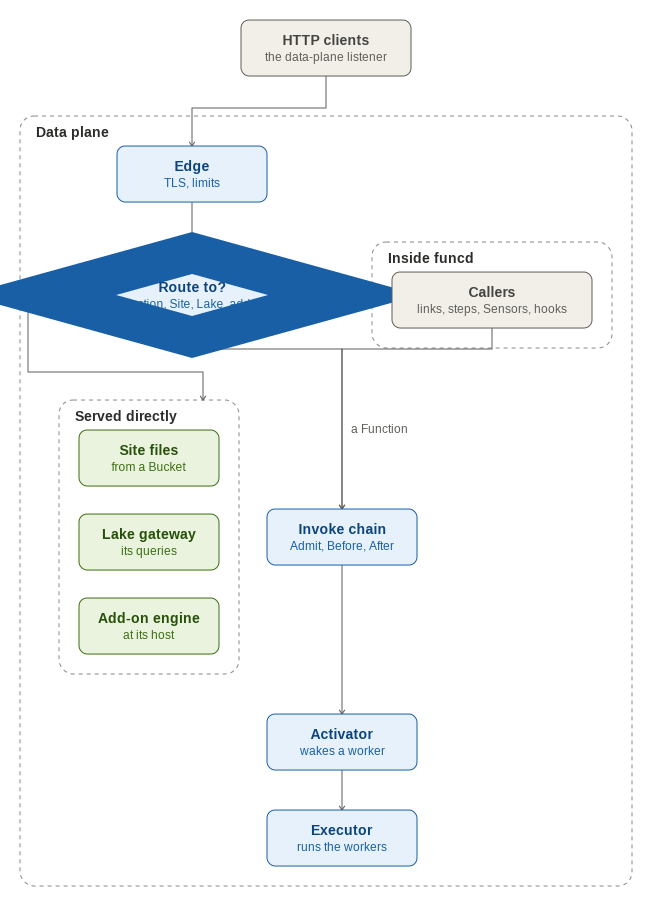
The data plane serves the calls. An HTTP client's call reaches the edge, which has a listener of its own and routes the call to a Site's files, a Lake's gateway, an add-on object's engine or a Function. A call to a Function runs the invoke chain, whether it comes from the edge or from inside funcd. The calls from inside funcd are a Function's or a Job's call over a link, a workflow step, a Sensor's action, an App's hook and an add-on kind's objects. The activator then hands the call to a ready worker, and starts one when the Function has none. The Executor runs the workers.
Edge
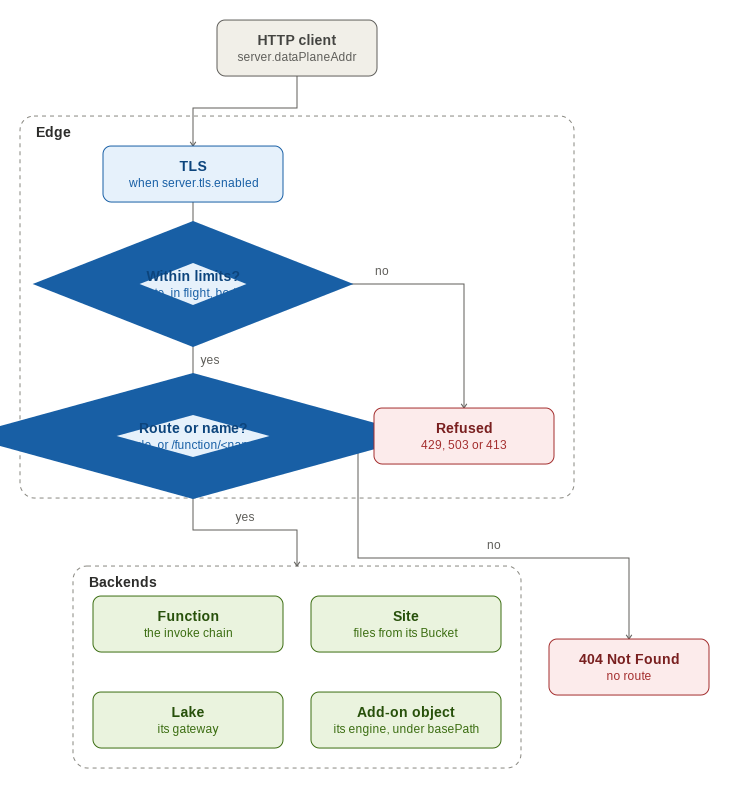
The edge listens on server.dataPlaneAddr, apart from the API. By default, it uses a free port on loopback. It
terminates TLS when server.tls.enabled is set, with a self-signed certificate by default, with a certificate that the
operator provides (provided), or with one from Let's Encrypt (acme). Its limits are off by default. server.limits
sets a rate per minute for each client IP, a cap on the calls in flight and a body size. The edge refuses a call over
these limits with 429, 503 and 413 respectively, before any worker starts. It can also log each call, record metrics and
traces (server.observability), and set CORS, compression and headers (server.shaping).
The edge then matches the call against the rules of the Ready Routes. The longest path wins, and a host breaks a tie.
A rule with no host answers on <namespace>.<baseDomain>, or on any host when its namespace is default. When no rule
matches, /function/<name> calls the Function by name, unless its namespace's defaultExposure is explicit. Any
other call gets 404. The edge passes a Function's call to the invoke chain, serves a Site's files from its Bucket
prefix, passes a Lake's queries to the Lake's gateway, and passes a call to an add-on object's host to its engine,
under its Addon's basePath, with 404 for one of its private paths.
Invoke chain
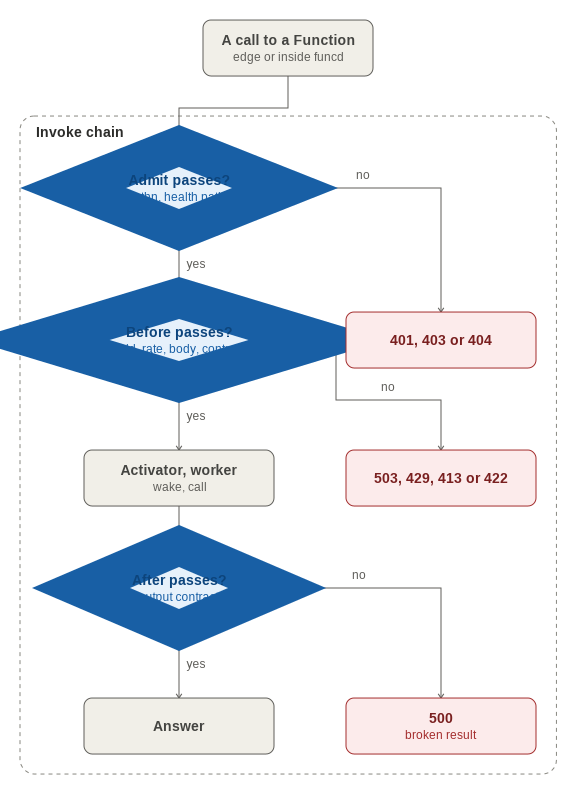
Every call to a Function's worker runs the invoke chain, which checks the call at three points. Admit runs before
funcd reads anything about the Function. When the call's auth stance is authenticated, as set by its Route or by its
namespace's default, the caller needs a token that lets it get the Function under RBAC. Otherwise, the call gets 401
or 403. A path under /health/ gets 404, so no worker starts.
Before runs before the worker is called or started. A namespace that is held for its data refuses the call with 503,
and a rate per Function refuses it with 429. The body becomes the CloudEvent that the worker receives, and a body over
1 MiB gets 413. The call then gets its deadline: the Function's spec.timeout, else invoke.defaultTimeout, 60 s. A
call past its deadline gets 504. Last, Before checks the input against the Function's contract, and an input that
breaks it gets 422. After runs once the worker has answered: a result that breaks the output contract becomes a 500.
A call from inside funcd skips the edge. A Function's call over a link meets only the hold and the contract. It keeps
its own timeout, 30 s or the link's timeout, and gets 429 when 10 such calls to one Function are already in flight
(invoke.maxNestedInFlight).
Activator
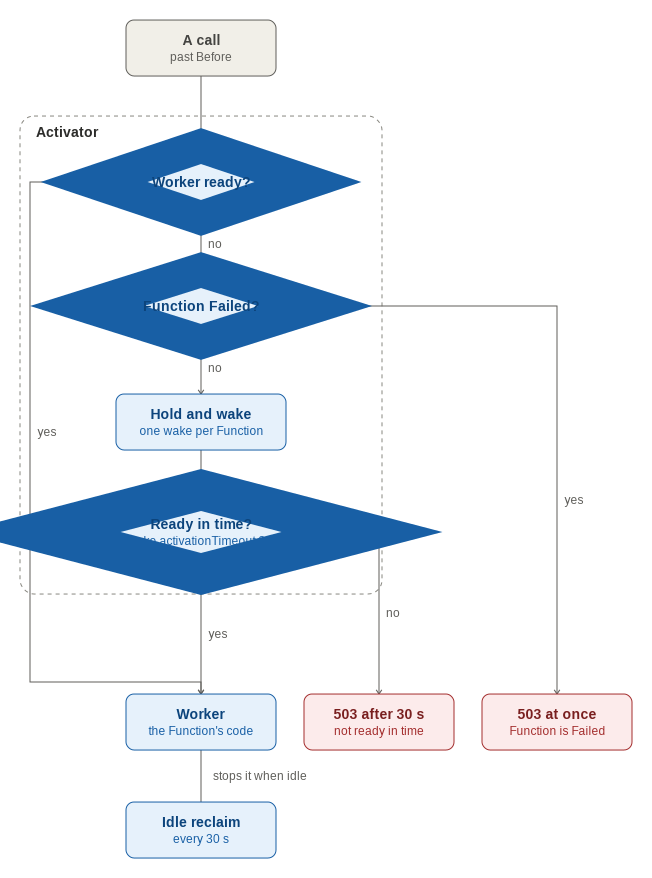
The activator hands a call to a ready worker. When the Function has none, the activator holds the call and starts a
worker. One start serves all the calls that arrive in the meantime, and they share its timeout, so a call that arrives
later waits less. When the worker is ready, the activator passes the held calls on. A call gets 503 at once when the
Function is Failed, and 503 when no worker is ready within invoke.activationTimeout, 30 s.
Every 30 s (invoke.reclaimInterval), the activator stops the workers of a Function that has served no call for its
spec.scaling.idleTimeout. The Function then reads Idle. This does not happen when its minReplicas is above 0.
With replicas above 1, every call goes to the lowest listening replica, and the other replicas wait as spares.
Executor
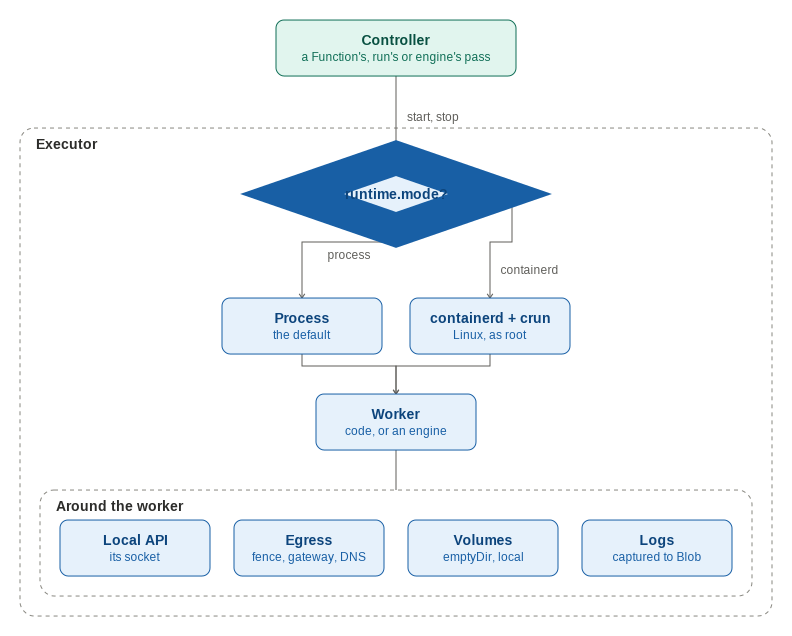
The Executor runs the workers that the controller's pass of a Function or of a JobRun asks for. runtime.mode picks its
driver. The default, process, runs each worker as a host process, without isolation, enforced limits or volumes.
containerd, on Linux as root, runs each worker in its own container with crun, on its own network. Several Functions
can share one pooled worker, but only on process.
The passes of Lakes, SQLDatabases and add-on objects ask the Executor for their engines, which it runs on the same
driver. On containerd, an add-on's engine is fenced: it admits connections only from loopback and funcd's bridge
address, so a Function reaches it only through funcd, with ctx.addon.fetch on its local API, or with any HTTP client
through the add-on proxy, which checks the Function's token.
Around each worker, the Executor opens its local API socket under <dataDir>/invoke. When server.network.egress is
on, it applies the worker's egress through the fence, the egress gateway and the DNS forwarder. It mounts the worker's
volumes, emptyDir or local, and captures its logs to the funcd-system bucket in Blob, where funcdctl logs
reads them. It captures an engine's output there too, which funcdctl logs <kind>/<name> reads.
A worker must listen within runtime.bootTimeout, 1 min, and answer its readiness check before it takes calls. A
worker that exits after it listened is replaced after runtime.supervisionPeriod, 10 s. A worker that keeps crashing
at boot is started again after a wait that doubles from 10 s to 5 min. A stop sends SIGTERM, then SIGKILL after the
grace period, which is 10 s on containerd and 3 s on process.